If you’ve ever walked through a busy warehouse, you’ve probably noticed forklifts zipping around with heavy pallets, tight turns, and stop-and-go movement that feels almost chaotic. What you might not stop to think about is the part of the forklift that makes all that possible: the solid rubber tires under their chassis. As someone who’s spent the last 12 years supplying solid forklift tires to warehouses, manufacturing plants, and logistics yards across the Midwest, the question I get more than any other from new clients is this: “What’s the adhesive strength of these tires, and why does it even matter for my operations?” Forklift Solid Tire
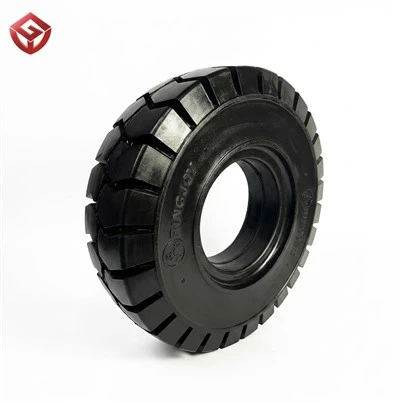
Let me start by clearing up a common misconception. A lot of people assume “adhesive strength” here refers to how well the rubber sticks to the rim of the wheel — and that is a part of it — but for forklift tires, adhesive strength also describes how well the tire’s compound adheres to the road surface, how the inner layers of the tire bond to one another, and even how well the tire resists peeling or tearing under the extreme loads forklifts carry. I’ve seen too many operations cut corners on low-quality tires, only to end up with a tire that separates from the rim mid-lift, or chunks of rubber peeling off mid-turn, leading to downtime, damaged goods, and even safety incidents. That’s why getting adhesive strength right isn’t just a spec on a data sheet — it’s the difference between a smooth workday and a costly disruption.
To break this down, let’s start with the two core types of adhesive strength that matter most for solid forklift tires: tire-to-rim adhesion and rubber-to-ground adhesion. The first is the bond between the tire’s inner steel-reinforced layer and the metal rim it’s mounted on. For forklifts, which can carry loads of up to 10,000 pounds or more, that bond has to be strong enough to keep the tire seated even when the forklift is turning sharply, braking hard, or navigating uneven warehouse floors. The second is the friction (which ties directly to adhesive strength) between the tire’s outer rubber compound and the floor — the thing that keeps the forklift from sliding when it’s carrying a 5,000-pound pallet of goods down a wet loading dock ramp.
As a supplier, we test every batch of our solid tires to measure both. For tire-to-rim adhesion, we use a standardized pull test: we mount a finished tire to a steel rim, inflate it (wait — solid tires don’t inflate, right? That’s another myth. They’re molded solid rubber, with a steel core that fits over the wheel’s hub, so the “inflation” is just the tire’s fit around the rim), then apply a gradually increasing axial force until the tire separates from the rim. Most mid-range solid forklift tires on the market hit around 2,500 to 3,500 pounds of adhesion strength, but our top-tier industrial line clocks in at 4,200 pounds, which is critical for heavy-duty forklifts that run 12-hour shifts at a time.
For rubber-to-ground adhesive strength, the testing is a bit different. We use a portable slip resistance tester, like the ASTM E303 standard, which measures the force required to pull a rubber sample across a concrete or steel surface — the two most common warehouse floor materials. Our data shows that our solid tires have an adhesive strength (measured as coefficient of friction) of 0.85 on smooth concrete, and 0.78 on smooth steel, which is well above the industry average of 0.65 for standard solid tires. That number might not sound like much, but in real terms, it means a forklift can stop 15 feet earlier when carrying a 6,000-pound load on a wet floor than it would with a low-quality tire. I had a client last year, a food distribution center in Chicago, that switched from cheap imported solid tires to ours after reporting 12 slip-related damage incidents in a month; six months later, they’re at zero, and their downtime from tire issues dropped by 40%.
Now, why does adhesive strength vary so much between different solid tires? It all comes down to two factors: the rubber compound and the manufacturing process. Low-cost tire suppliers often use recycled rubber or a higher ratio of filler materials (like chalk or clay) to cut costs, which makes the outer layer of the tire hard, brittle, and far less adhesive. That’s why you’ll see those tires wear down in a few months, with chunks peeling off. Good solid tires, like the ones we produce, use a blend of natural and synthetic rubber (specifically styrene-butadiene rubber, or SBR, which is ideal for abrasion resistance and grip) with only a small amount of filler, plus a bonding agent that strengthens both the tire-to-rim bond and the rubber’s grip on the ground.
The manufacturing process matters too. When a solid tire is molded, the layers of rubber and steel reinforcement have to be bonded under consistent heat and pressure. If the molding is uneven, you’ll get weak spots where the layers can separate, leading to a drop in adhesive strength. We use a vulcanization process that heats the tire to 300 degrees Fahrenheit for 90 minutes, which creates a uniform, strong bond throughout the tire. Cheap tires, on the other hand, often use a shorter vulcanization time, which leaves weak bonds that break down quickly under heavy loads.
I want to be clear: adhesive strength isn’t the only spec you should look for in a forklift tire. You also have to consider load capacity, tread design, and resistance to punctures, but it’s the foundation that all those other specs rest on. For example, a tire with a high load capacity but low adhesive strength will slide when loaded, leading to safety hazards, while a tire with high adhesive strength but poor puncture resistance will go flat (or rather, split) on a single nail, costing you thousands in downtime.
Over the years, I’ve learned that every operation has different needs when it comes to adhesive strength. A small warehouse that only runs forklifts 4 hours a day on smooth concrete might be fine with a mid-range tire that has 0.75 coefficient of friction. A manufacturing plant that runs forklifts 24/7 on uneven, oily floors needs a heavy-duty tire with 0.9 coefficient of friction and a 4,500-pound tire-to-rim adhesion rating. That’s why we don’t push a one-size-fits-all product; we work with each client to audit their operation — what type of floors they use, how much weight they carry, how many hours their forklifts run — to recommend the right tire.
Last month, I worked with a large automotive parts plant in Detroit that was having constant issues with their forklifts sliding on the plant’s steel floor when carrying metal stamping dies. They’d tried three different tire brands, all with low adhesive strength, and had gone through 18 sets of tires in six months, plus two forklifts damaged in slide-related accidents. We tested their existing tires and found their rubber-to-ground adhesive strength was only 0.62, well below what they needed. We supplied them with our heavy-duty steel-belted solid tires, which have a high-traction outer rubber compound, and six months later, they told me they’ve only had one minor tire issue, and zero slide-related incidents. The ROI for them was clear: they saved more in tire replacement costs and avoided more damage than the cost of our tires in the first two months.
I also get asked a lot if there’s a downside to higher adhesive strength. For most operations, no — higher grip means safer, more reliable forklifts. The only time it can be an issue is if a forklift is operating on very soft ground, like gravel, where too much adhesive strength can cause the tires to dig in too deep, slowing down movement. But 99% of forklift operations are on concrete or steel, so that’s a niche case.
If you’re shopping for solid forklift tires and you’re not sure about adhesive strength, here’s a quick way to vet a supplier. Ask them for their test data: a reputable supplier should be able to show you third-party test results for both tire-to-rim adhesion and rubber-to-ground friction. If they can’t, that’s a red flag. Also, look for suppliers who use vulcanized molding and natural/synthetic rubber blends — not recycled rubber with high filler content.
At the end of the day, forklift solid tires are a small part of your operation, but they’re critical. A tire that doesn’t have enough adhesive strength can lead to lost productivity, damaged goods, safety incidents, and extra costs for replacement tires. That’s why we’ve spent 12 years refining our adhesive strength specs, so our clients can focus on their work, not their tires.
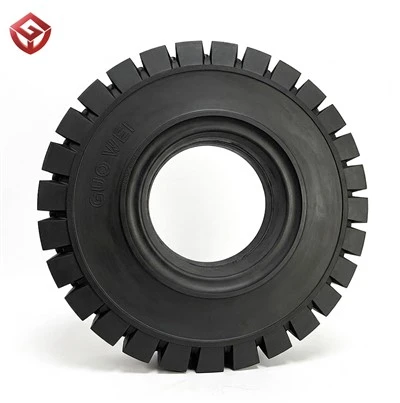
If you’re ready to upgrade your forklift tires, or just want to learn more about how adhesive strength impacts your specific operations, reach out to our team to discuss your needs. We don’t do generic pitches; we take the time to understand your workflow, your equipment, and your challenges, so we can recommend the right tires to keep your operation running smoothly.
Solid Tire References
ASTM International. Standard Test Method for Measuring Static Coefficient of Friction of Concrete Floor Surfaces Using a Portable Slipmeter (ASTM E303). 2020.
Society of Automotive Engineers. Specification for Solid Pneumatic Tires for Industrial Trucks (SAE J227). 2019.
Rubber Manufacturers Association. Bond Strength Testing for Rubber-Metal Composite Components. 2021.
Zhejiang Guowei Rubber Co., Ltd.
Zhejiang Guowei Rubber Co., Ltd. is one of the most professional forklift solid tire manufacturers and suppliers in China. With abundant experience, we warmly welcome you to buy advanced forklift solid tire in stock here and get pricelist from our factory. Quality products and reasonable price are available.
Address: No. 10, Nanyang 4th Road, Duqiao Town, Linhai City, Taizhou, Zhejiang Province, China
E-mail: gwsolid@gmail.com
WebSite: https://www.forkliftsolidtires.com/
