When you order custom socks for your brand, team, or special event, you probably spend a lot of time picking colors, patterns, and sizes—but have you ever thought about the ink that goes into printing those designs? As a custom socks supplier, I get this question all the time, and for good reason: the right ink doesn’t just make your design look sharp; it determines how long your socks hold up through washes, how they feel on your skin, and even how vibrant your design stays over time. Let me break down what we use and why it matters. Custom Socks
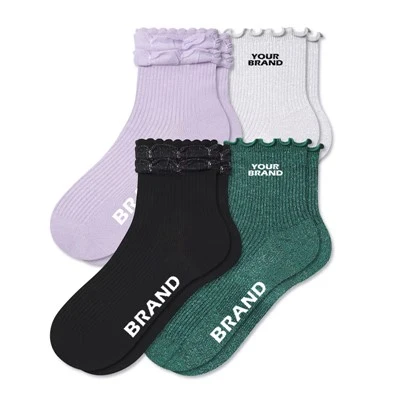
First, it’s important to remember that socks aren’t like t-shirts or posters. Most custom socks are made from a blend of materials, usually cotton, polyester, spandex, or a mix of all three, and they’re stretchy, soft, and often worn for activities—whether that’s at a soccer practice, a trade show giveaway, or a casual day at work. So the ink has to work with those materials, not against them. You can’t just grab any ink from a craft store; it needs to be flexible, durable, and safe for direct skin contact.
Let’s start with the most common ink we use: water-based ink. If you’ve ever had a custom graphic t-shirt printed, you might be familiar with this, but it’s even more critical for socks. Water-based ink is made with pigment suspended in water, which means it’s light, breathable, and doesn’t add a stiff, bulky feel to the design. That’s a big win for socks—no one wants a thick, scratchy logo rubbing against their heel all day. Unlike plastisol ink (which I’ll talk about next), water-based ink seeps into the fabric fibers instead of sitting on top, so it looks more natural and stays flexible even when the sock stretches.
But here’s the catch: water-based ink is best for lighter or white sock materials. If you’re printing on dark cotton or dark polyester, the water-based pigment might not show up as vibrantly because it’s transparent, not opaque. For light-to-medium fabrics, though, it’s our go-to. We use water-based ink for most of our team socks and casual custom orders because it’s also eco-friendly—no harsh chemicals, and it washes out clean without leaving residue on your skin. I once had a customer tell me their soccer team’s socks printed with water-based ink didn’t cause any of the blistering or skin irritation some of their old cheap socks did, which was exactly the feedback we want to hear.
Now, what if you’re printing on dark socks, or you need a design that’s extra bold? That’s where plastisol ink comes in. Plastisol is a PVC-based ink that’s thick, opaque, and super durable. It sits on top of the fabric, so it’s perfect for bright, high-contrast designs on dark fabrics—think neon logos on black socks. The trade-off? Plastisol is a bit thicker, so if you print a design that’s too big or too heavy, it can feel a little stiff. But modern plastisol formulations are way more flexible than they used to be, especially when we use a reduced-gel blend, which softens the ink so it moves with the sock. We also use a process called flash curing when printing plastisol: after each layer of ink, we flash it with a heat gun to set it, which prevents the ink from cracking when the sock stretches.
I’ve learned over the years that plastisol is the best choice for customers who want their socks to hold up to heavy use. For example, a local construction company ordered custom work socks with their logo in bright orange on black polyester, and those socks have been going through daily washes and wear for over a year—no cracking, no fading, the logo is still as sharp as the day they got them. That’s the power of a good plastisol formulation.
Wait, but what about the stretchy part? Socks have spandex, right? Spandex is elastic, so the ink has to stretch too. That’s why we don’t use old-school plastisol that’s rigid. We use stretchable ink versions of both water-based and plastisol, specifically formulated to expand and contract with the fabric. If the ink is too stiff, every time you pull the sock on or off, or your foot stretches the fabric, the ink will crack and peel. I’ve seen customers come back with socks where the logo was flaking off after a few washes, and 9 times out of 10, it was because the wrong ink was used, or the ink wasn’t properly cured. Curing is another big step—we use a commercial heat press to cure the ink at the exact temperature and time it needs, so it bonds to the fabric correctly. No half-curing here; that’s a quick way to get peeling socks.
Another type of ink we use less often, but still for specific orders, is discharge ink. Discharge ink is almost the opposite of water-based: instead of adding pigment to the fabric, it removes the dye from dark socks to create a design. So if you have a dark navy sock and you want a white or light-colored design, discharge ink will bleach out the fabric where you print, leaving a soft, natural color that blends with the sock. It’s great for vintage or distressed designs because the result looks like it’s part of the fabric, not a sticker. The downside is that discharge ink only works on 100% cotton (or a high cotton blend) and can discolor if not applied correctly. We test a small swatch first for every discharge order to make sure the color turns out right—no one wants a custom sock with a weird gray patch where their logo should be.
I get a lot of questions about safety too, and rightfully so. Socks are in direct contact with skin, especially for people with sensitive skin or allergies. All of the inks we use are OEKO-TEX certified, which means they’re tested and free of harmful substances like lead, phthalates, and formaldehyde. That’s non-negotiable for us. I once had a customer with a kid’s soccer team who was worried about ink irritating their child’s skin, so we walked them through our certification process and even sent them a sample sock to test at home. They came back and ordered 200 pairs, saying their kid didn’t have any redness at all. That’s the kind of trust we build by being transparent about what goes into our products.
So how do we choose which ink to use for a custom order? It’s not just about the design color—we look at the sock material, the expected use, and the customer’s priorities. If it’s a casual, light-use sock for a trade show giveaway, water-based is usually our pick because it’s soft and eco-friendly. If it’s a work sock or a team sock that will get washed dozens of times, plastisol with reduced gel is better for durability. If the customer wants a distressed or vintage look on cotton, discharge ink is the way to go. We also offer a combination: for example, printing a base layer of water-based ink on a light sock and a small accent of plastisol for a bright logo detail.
I should also mention the difference between screen printing and digital printing, because that affects the ink too. Most custom socks are screen printed, which uses the inks I’ve been talking about—water-based, plastisol, discharge. But for small orders or very intricate designs, some suppliers use digital printing with sublimation ink. Sublimation ink is different because it turns into a gas and bonds with the fabric’s fibers, so it’s super vibrant and doesn’t feel stiff. The downside is that sublimation only works on 100% polyester, and you can’t print white with it because it’s transparent. We don’t offer sublimation printing for socks because our customers mostly order blends of cotton and polyester, and sublimation doesn’t work as well on those. But it’s an option if you’re only using polyester and have a small order.
One of the biggest mistakes I see new custom sock customers make is choosing an ink based on price alone. Cheaper inks might save you a few dollars per pair, but they’ll fade, crack, or irritate skin way faster. Last year, a small business owner came to us after ordering custom socks from another supplier—their logo was peeling after two washes, and the ink had stained their feet. We switched them to our stretchable plastisol ink, and their new socks have held up for six months. It’s worth spending a little more on the right ink to make sure your custom socks do what they’re supposed to: represent your brand, keep feet comfortable, and last.
At the end of the day, the ink is the bridge between your design and the sock. It’s not just a coat of color; it’s what makes the design feel good to wear and look good after months of use. Whether you’re ordering custom socks for a event, team, or business, take a minute to ask your supplier about their ink choices—you’ll be glad you did.

If you’re ready to talk through your custom sock project, share your design ideas, and find out exactly what ink will work best for you, reach out to us to start a conversation. We’re here to walk you through every step, from material to ink to finishing touches, to make sure your custom socks turn out exactly how you want them.
Sock Gift Set References
- OEKO-TEX Association. (n.d.). OEKO-TEX Standard 100: Testing for Harmful Substances in Textiles.
- Textile Institute. (2021). Screen Printing for Stretch Fabrics: Key Considerations for Elastic Garments.
- SGS. (2020). Plastisol vs. Water-Based Ink: Performance and Durability for Apparel Printing.
- Smith, J. (2019). Discharge Printing: Techniques and Applications for Cotton Textiles. Journal of Apparel Technology and Management.
Zhuji Fuchun Knitting Co., Ltd.
As one of the most professional custom socks manufacturers and suppliers in China, we offer a wide range of products with superior quality. Please feel free to wholesale bulk high quality custom socks made in China here from our factory.
Address: Building 6, No. 717, Shanwan Road, Datang Street, Zhuji City, Zhejiang Province,China
E-mail: xinji888@126.com
WebSite: https://www.fuchunsocks.com/
