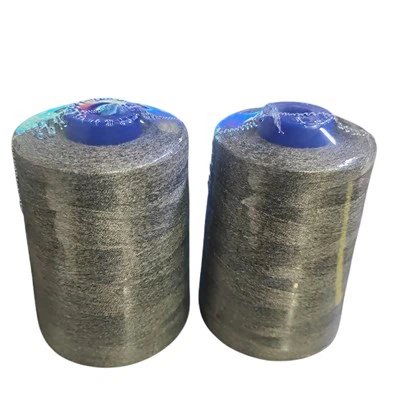
As a supplier of Conductive Composite Yarn, I’ve witnessed firsthand the fascinating interplay between various materials and the conductivity of our products. In this blog, I’ll delve into how the addition of other materials affects the conductivity of Conductive Composite Yarn, exploring the science behind it and sharing real – world implications. Conductive Composite Yarn
Understanding Conductive Composite Yarn
Conductive Composite Yarn is a remarkable material that combines the flexibility and processability of traditional yarns with the electrical conductivity of conductive materials. It has found applications in a wide range of industries, from smart textiles to electronics. At its core, the yarn is designed to conduct electricity, enabling it to be used in applications such as sensors, heating elements, and electromagnetic shielding.
The Role of Base Materials
The base material of Conductive Composite Yarn is typically a non – conductive fiber, such as polyester or nylon. These fibers provide the mechanical strength and flexibility required for the yarn to be woven or knitted into various fabrics. However, on their own, these base materials do not conduct electricity. To introduce conductivity, conductive materials are added to the yarn.
Adding Conductive Fillers
One of the most common ways to enhance the conductivity of Conductive Composite Yarn is by adding conductive fillers. These fillers can be in the form of particles, fibers, or flakes. Some of the most widely used conductive fillers include carbon black, carbon nanotubes, and metal nanoparticles.
Carbon Black
Carbon black is a popular choice for conductive fillers due to its relatively low cost and good conductivity. When added to the yarn, carbon black particles form a conductive network within the base material. The conductivity of the yarn increases with the amount of carbon black added, up to a certain point. However, excessive amounts of carbon black can also lead to a decrease in the mechanical properties of the yarn, such as its strength and flexibility.
Carbon Nanotubes
Carbon nanotubes are another excellent conductive filler. They have extremely high electrical conductivity and aspect ratios, which means they can form a more efficient conductive network compared to carbon black. The addition of carbon nanotubes can significantly enhance the conductivity of the yarn, even at low concentrations. However, carbon nanotubes are more expensive than carbon black, and their dispersion in the base material can be challenging.
Metal Nanoparticles
Metal nanoparticles, such as silver or copper, are also used as conductive fillers. These nanoparticles have high electrical conductivity and can provide excellent conductivity to the yarn. However, they are more expensive than carbon – based fillers and may be more prone to oxidation, which can affect their long – term conductivity.
Impact on Conductivity
The addition of conductive fillers has a direct impact on the conductivity of Conductive Composite Yarn. As the concentration of the conductive filler increases, the number of conductive pathways within the yarn also increases, leading to an increase in conductivity. However, there is a critical concentration, known as the percolation threshold, beyond which the conductivity increases more rapidly.
Percolation Threshold
The percolation threshold is the minimum concentration of conductive filler required to form a continuous conductive network within the base material. Below this threshold, the conductivity of the yarn is relatively low because the conductive particles are not connected. Once the percolation threshold is reached, the conductivity increases significantly as the conductive network becomes continuous.
Conductivity vs. Filler Concentration
The relationship between conductivity and filler concentration is not always linear. At low concentrations, the increase in conductivity may be relatively small. As the filler concentration approaches the percolation threshold, the conductivity starts to increase more rapidly. After the percolation threshold, the conductivity continues to increase, but at a slower rate.
Other Factors Affecting Conductivity
In addition to the type and concentration of conductive fillers, other factors can also affect the conductivity of Conductive Composite Yarn.
Dispersion of Fillers
The dispersion of conductive fillers in the base material is crucial for achieving good conductivity. If the fillers are not well – dispersed, they may form aggregates, which can reduce the efficiency of the conductive network. To ensure good dispersion, various techniques can be used, such as mechanical mixing, sonication, and the use of dispersing agents.
Orientation of Fillers
The orientation of conductive fillers within the yarn can also affect its conductivity. In some cases, aligning the fillers in a specific direction can enhance the conductivity along that direction. For example, in a yarn with carbon nanotubes, aligning the nanotubes parallel to the yarn axis can increase the conductivity in the axial direction.
Interaction with the Base Material
The interaction between the conductive fillers and the base material can also impact conductivity. If the filler has a strong chemical interaction with the base material, it may improve the adhesion between the filler and the base, leading to a more stable conductive network. On the other hand, if the interaction is weak, the filler may be more likely to segregate or be removed from the yarn, reducing its conductivity.
Real – World Applications
The ability to control the conductivity of Conductive Composite Yarn through the addition of other materials has opened up a wide range of real – world applications.
Smart Textiles
In the field of smart textiles, Conductive Composite Yarn is used to create fabrics that can sense and respond to various stimuli. For example, conductive yarns can be used to create sensors that detect changes in temperature, pressure, or humidity. These sensors can be integrated into clothing, allowing for the development of smart garments that can monitor the wearer’s health and well – being.
Electronics
Conductive Composite Yarn is also used in electronics, particularly in flexible and wearable electronics. The yarn can be used to create flexible circuit boards, antennas, and other electronic components. Its flexibility and conductivity make it an ideal material for applications where traditional rigid electronics may not be suitable.
Electromagnetic Shielding
Another important application of Conductive Composite Yarn is electromagnetic shielding. The yarn can be woven into fabrics to create shields that protect against electromagnetic interference. This is particularly important in industries such as aerospace, automotive, and telecommunications, where electromagnetic interference can cause malfunctions in electronic devices.
Conclusion

The addition of other materials to Conductive Composite Yarn has a profound impact on its conductivity. By carefully selecting the type and concentration of conductive fillers, as well as considering other factors such as dispersion and orientation, we can tailor the conductivity of the yarn to meet the specific requirements of different applications.
Conductive Composite Yarn As a supplier of Conductive Composite Yarn, I’m always excited to work with customers to develop customized solutions that meet their unique needs. Whether you’re in the smart textile, electronics, or electromagnetic shielding industry, we have the expertise and products to help you achieve your goals. If you’re interested in learning more about our Conductive Composite Yarn or discussing potential applications, please feel free to contact us for a procurement discussion.
References
- Ando, K., & Kuroda, K. (2010). Electrical conductivity of carbon nanotube composites. Journal of Applied Physics, 108(4), 044304.
- Baughman, R. H., Zakhidov, A. A., & de Heer, W. A. (2002). Carbon nanotubes – the route toward applications. Science, 297(5582), 787 – 792.
- Kim, J. H., & Lee, S. H. (2012). Electrical conductivity and mechanical properties of carbon black – filled polypropylene composites. Polymer Engineering & Science, 52(11), 2470 – 2476.
Haining Taierxin New Materials Co., Ltd.
Haining Taierxin New Materials Co., Ltd. is one of the most professional conductive yarn manufacturers and suppliers in China, specialized in providing high quality products. We warmly welcome you to wholesale bulk conductive yarn at competitive price from our factory.
Address: No.74, Anjiang Road, Jianshan New District, Haining City, Zhejiang Province, China.
E-mail: sue@taierxinfiber.com
WebSite: https://www.taierxinfiber.com/
